Manual›Jobs
How do I make an Instagram carousel and a whole social campaign with AI?
Describe the brand and ask for the slides. The Design & Media agent writes the brand system first, then builds every slide on it at 1080 × 1350, renders each one and looks at it before it shows you, and joins them into one PDF. The Saltwater Dawn swimming club below got its brand, a five-slide carousel and a harbour-café story in two runs of 12.6 and 13.5 minutes.
A real run: a cold-water swimming club, from nothing to five slides
A run on our machine, 24 September 2026, on DeepSeek V4.1 Flash.
The request carried four steps: build the design system, generate one hero photo, make a five-slide Instagram carousel on that system, then render every slide, fix what was weak and export a PDF — "without stopping to ask me between steps."
New brand from scratch: Saltwater Dawn, a cold-water sea swimming club in Brighton. It launches 1 Nov 2026. Swims are 7am on Tue, Thu and Sat, meeting at the Palace Pier groyne, beside the blue lifeguard hut. It's for nervous beginners and office workers who want a morning reset, not athletes. The feel is bracing, bright and salty: early light, sea-glass greens, chalky white and one sharp signal colour. The tone is warm and a bit cheeky, "your first dip is the worst one".
It read five of its built-in skills first — social-post, building-a-design-system, creative-studio-guidance, building-a-screen and judging-what-came-back — then built.
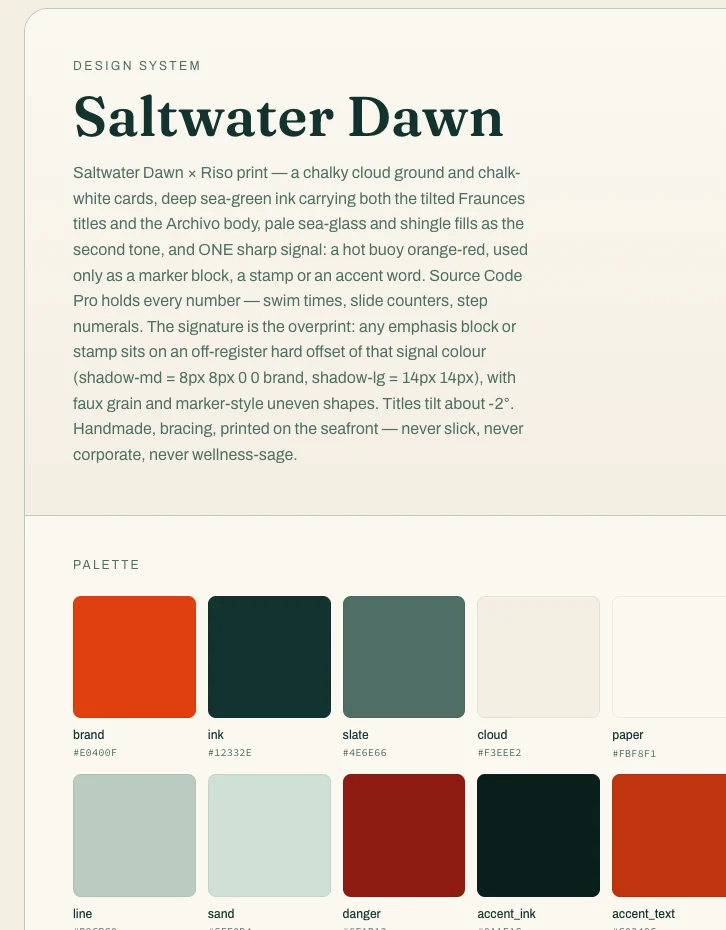
1 · The design system. Written before any slide: the design DNA paragraph, eight colour roles plus readable accent colours, a font trio, the spacing and corner scales. Every slide after this inherits it.
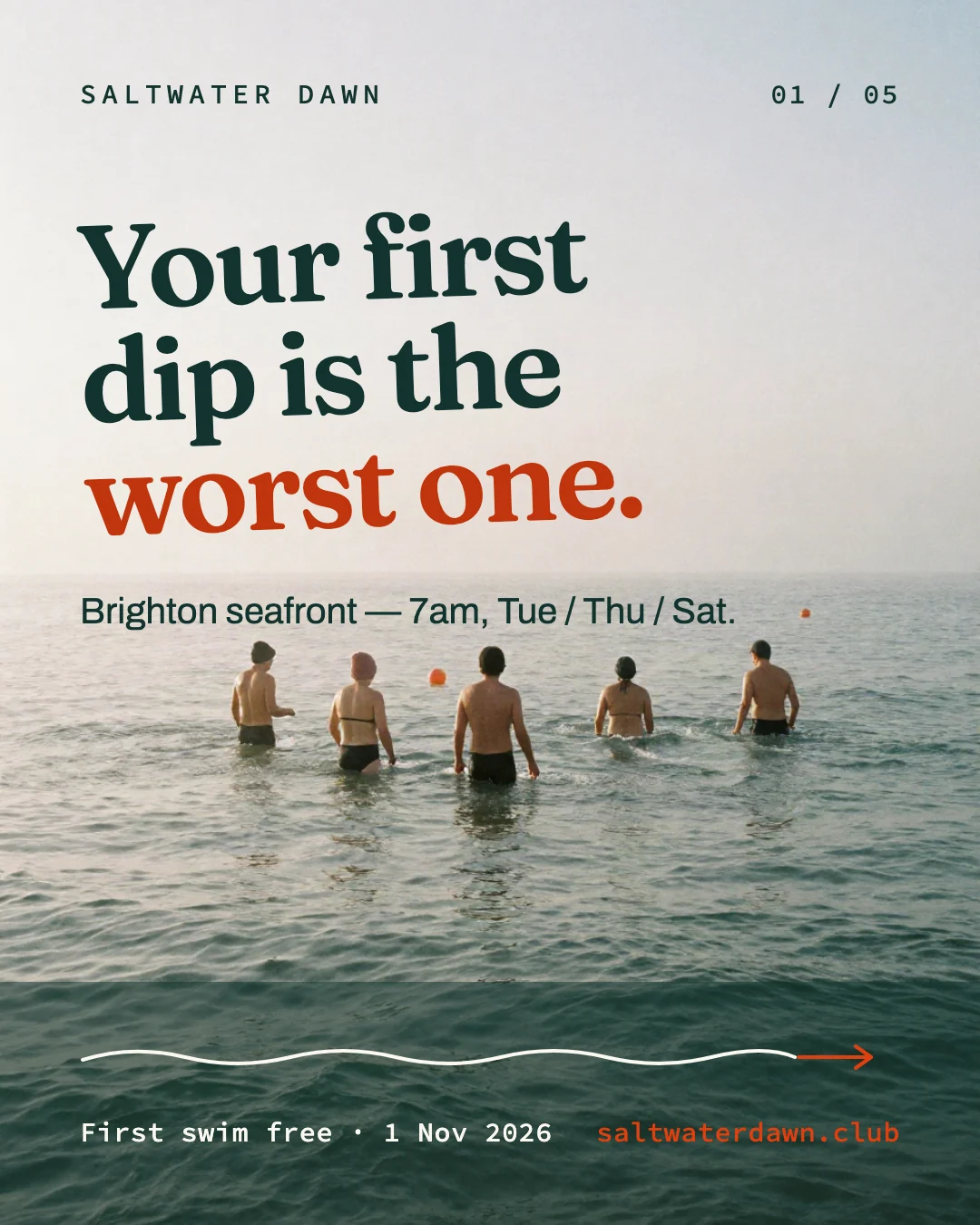
2 · The carousel. Five screens at 1080 × 1350, one card each on the canvas.
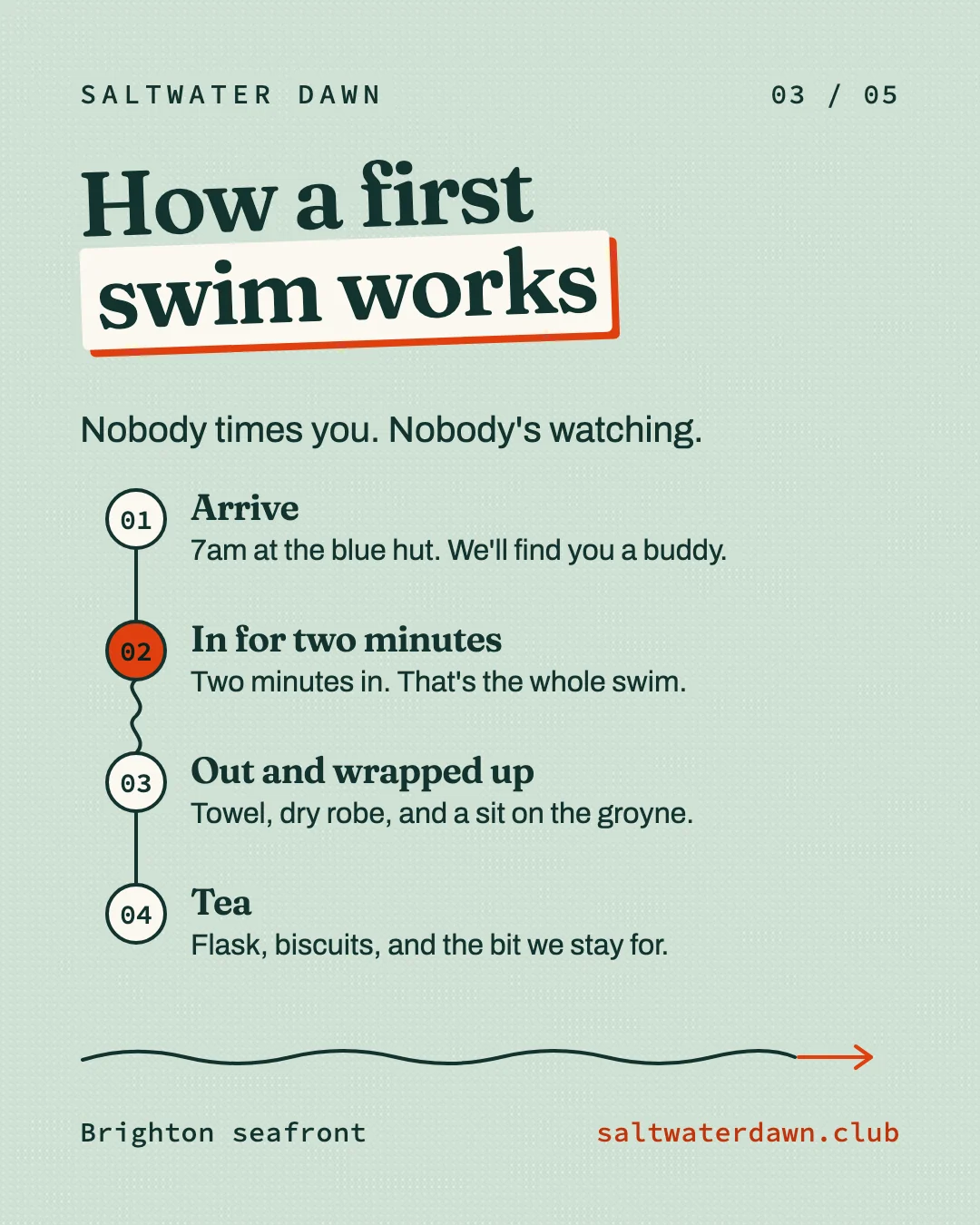
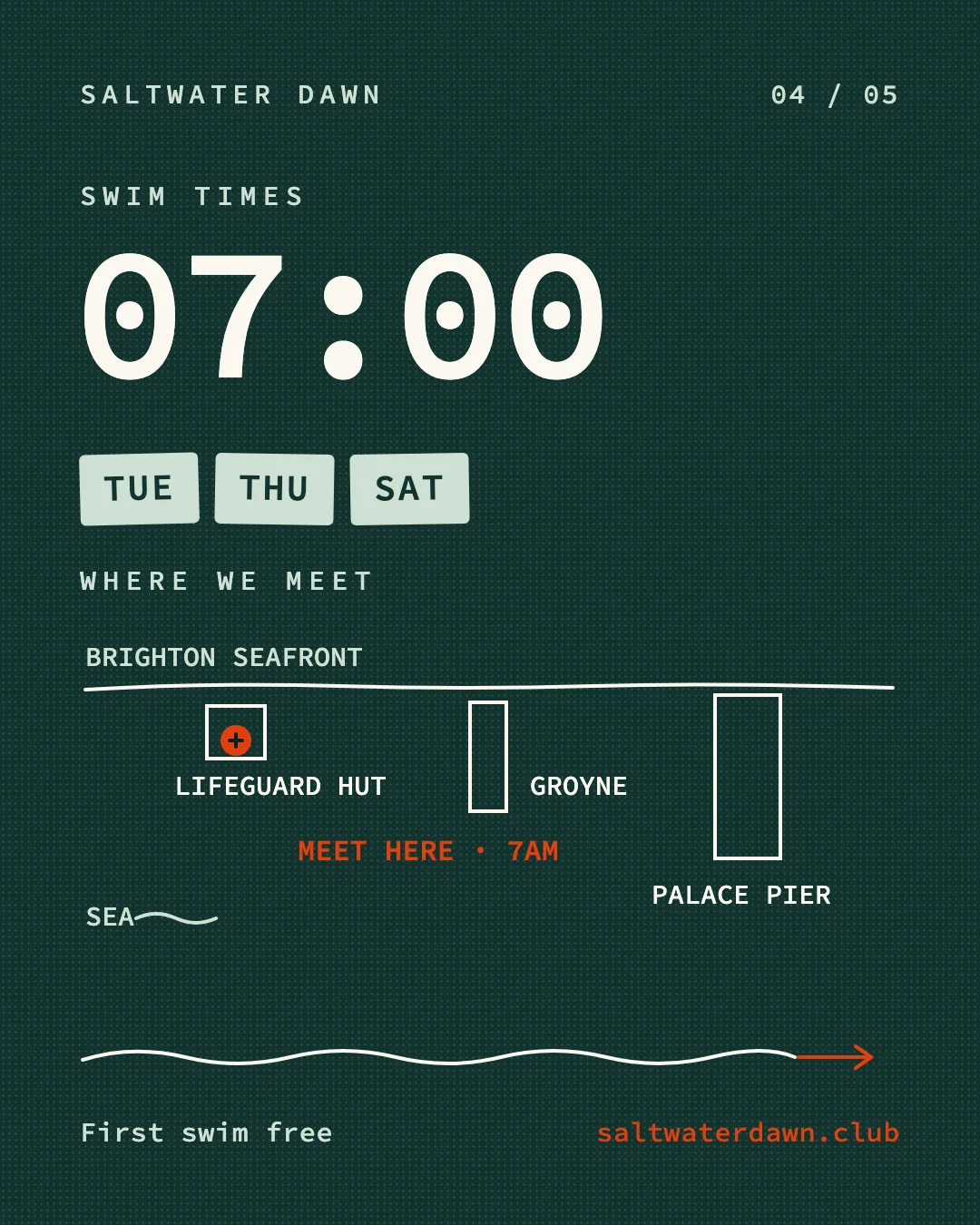
The fifth closes on "Your first swim is free." with "is free" in ink on the orange signal block, and a hand-drawn arrow into saltwaterdawn.club.
3 · The PDF. The five renders joined into one five-page carousel PDF, 1.0 MB, made on the machine.
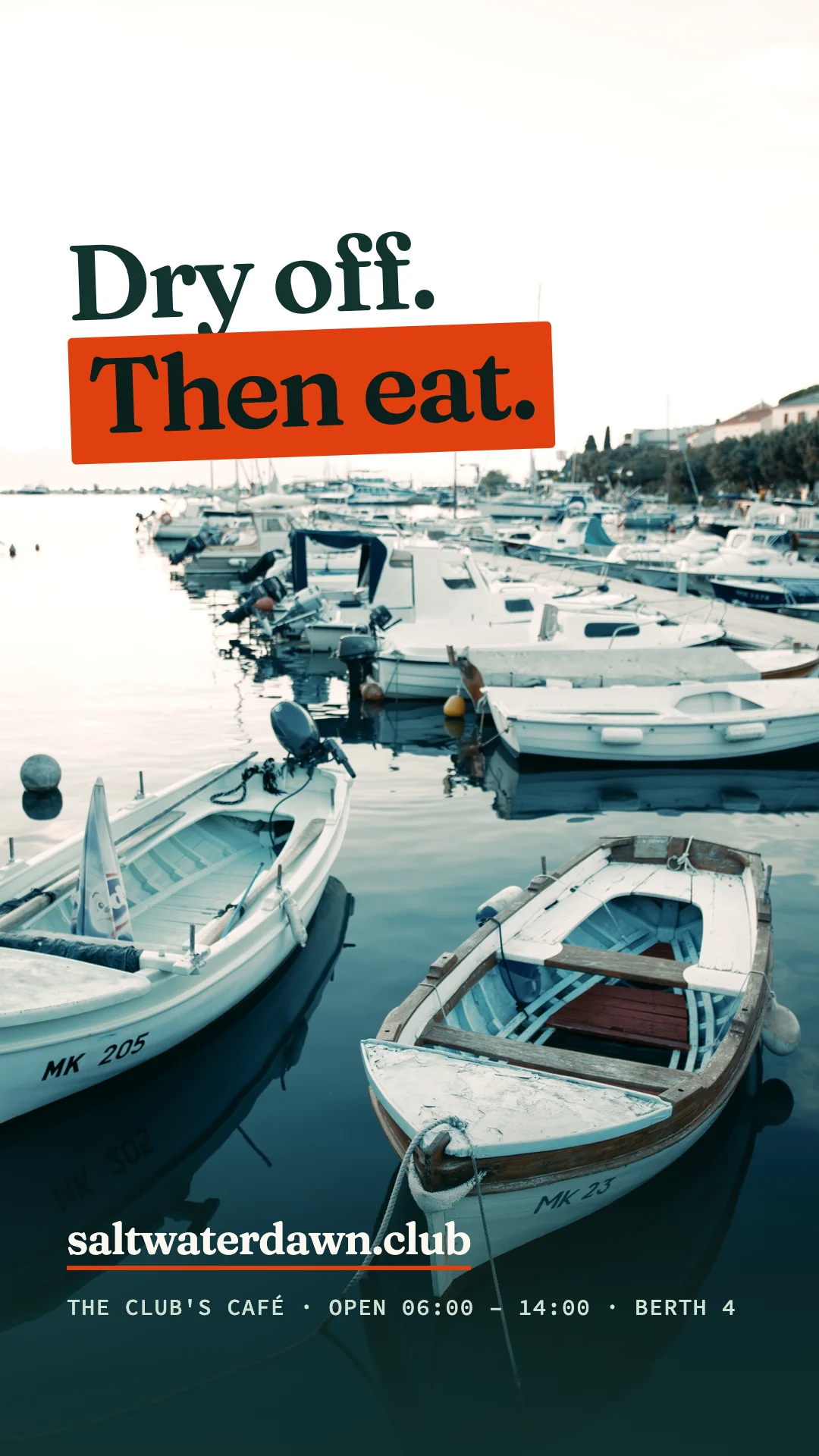
4 · The café story. A second piece on the same system: a 1080 × 1920 story for the club's own harbour café, on a real Pexels photo of boats at dawn, graded toward the palette and credited.
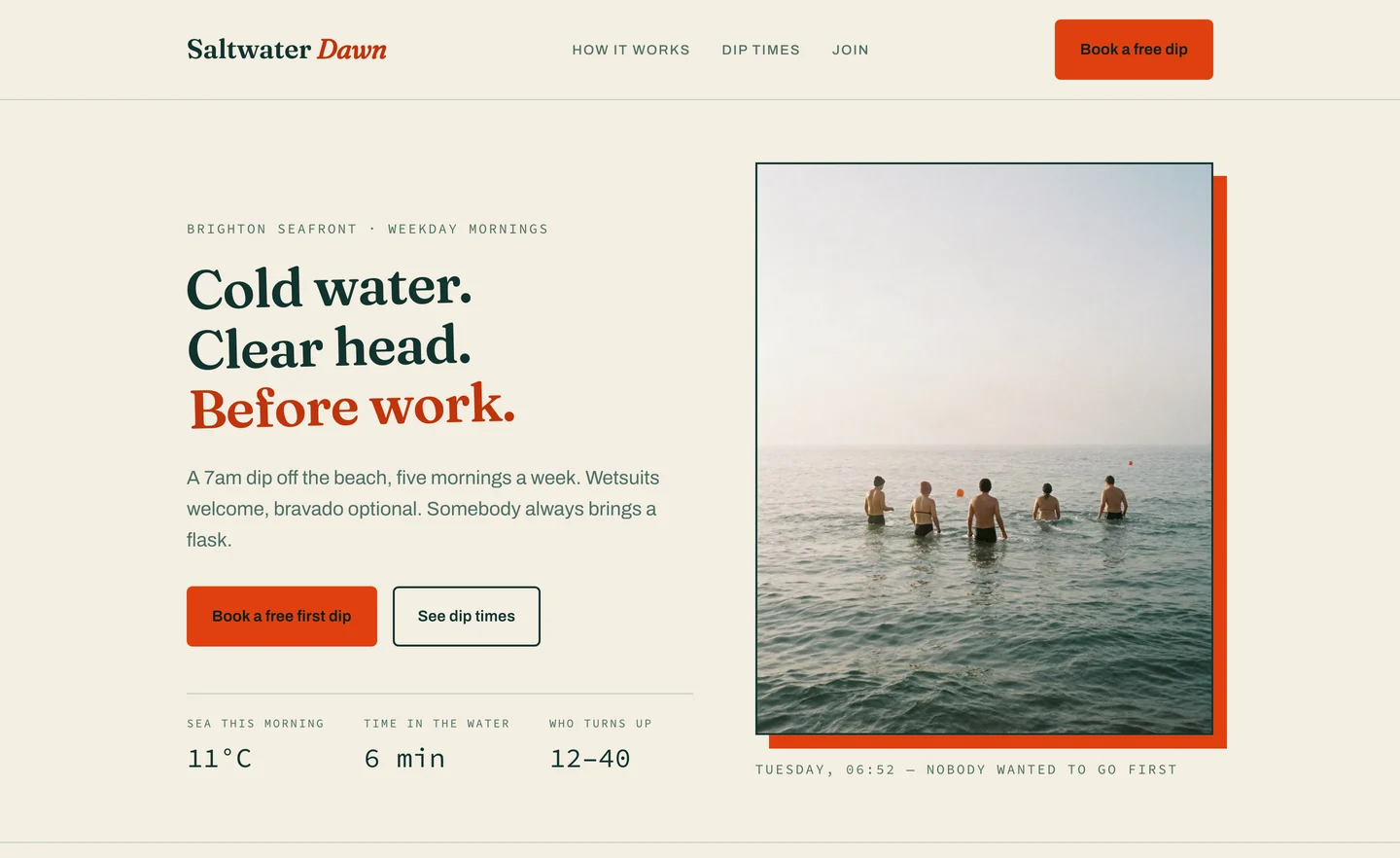
The same brand on a sample screen. The system also carries to a full app screen on the same canvas — hero, three steps, the dip-times table and the sign-up. Every name, figure and address on it is marked a placeholder.
What the Design & Media agent did
- Chose a base, then wrote the system by hand. It started from its Riso-zine style over an editorial-cream base: "a seaside club noticeboard is two-tone handmade print (cheeky, flat, off-register), not a polished magazine spread". It rejected the obvious pick, cyan and teal with Inter: the brief asked for sea-glass green, chalky white and one sharp signal. Chalky cloud
#F3EEE2, deep sea-green ink#12332E, sea-glass#CFE0D4and#B9CBC0, chalk cards#FBF8F1, buoy orange-red#E0400F, "never cyan, never teal". Fraunces for display, Archivo for body, Source Code Pro for every number. Titles tilt about −2°, and every emphasis block sits on an 8px off-register overprint, the way a misregistered Riso sheet does. When the system dropped that overprint token, it pinned the overprint onto the system's own shadow slots rather than restyling every slide by hand. - Generated the hero and took the service's answer. It asked for a documentary 35mm shot: five ordinary adult swimmers, mixed ages and body types, woolly hats, knee- to waist-deep in a grey-green sea at sunrise, steam on the water. The service refused the 4:5 crop it asked for — it accepts 1:1, 16:9, 9:16, 4:3, 3:4, 3:2 and 2:3 — so it resent at 3:4. What came back had five swimmers with their backs to the camera, a wide pale sky for the headline, and two small orange tow floats doing the accent's work.
- Built the slides as screens, not templates. Each was a 1080 × 1350 page bound to the system. On the diagram slide, the two minutes in the water are the wavy segment of the connector between steps 2 and 3, not a label. Slide 4 flips the palette to ink ground, sets
07:00in large mono and draws a schematic seafront: lifeguard hut, groyne, Palace Pier, and a pin on the meeting point. - Looked at every render, then fixed what it saw. Five footers had wrapped onto a second line, "PALACE PIER" was clipped at the card edge, an "in the water" label sat on a step title, two step lines orphaned a word, and Saturday wore a signal chip it had not earned. All fixed before it showed anything.
- Caught a failure that made no noise. Every slide was rendering in a fallback serif: the font trio had been given to the system in the wrong shape, so the font import it generated was broken. Nothing errored; the slides were simply not in Fraunces. It fixed the font trio at the system level, and all five slides re-tinted at once.
- Exported the PDF and wired the canvas. The five renders were joined into one five-page PDF on the machine, and all six files — five slide images and the PDF — were registered as assets and connected in reading order.
- Flagged the date rather than shipping it. 1 November 2026 is a Sunday, and the swims are Tuesday, Thursday and Saturday. Slide 1 could be read as a first swim on the 1st, so it said so and offered the split: "opens 1 Nov" plus "first swim free, Tue 3 Nov".
- Asked one question before the next piece. The same look can belong to the club's own café or to a separate café wearing it, so it asked, and kept the wordmark and
saltwaterdawn.clubon the answer "the club's own café". - Found a real photo, graded it and kept the credit. The stock search returned eight candidates from a pool of 8,000; it downloaded five and looked at all of them, chose Simon Petereit's "boats docked in a harbor" (4000 × 6000), and graded it toward the palette — ink-green shadows, warm dawn highlights — before placing it. The credit is saved beside the file and rides on the asset card.
- Took the notes mid-run. "Don't use placeholders" ended the bracketed fields; sample hours and a berth number replaced them, and the agent said they were sample. Two more notes shrank the text block; the last pass dropped the flat colour field, so the photo runs to the bottom edge and the type sits on the harbour's own dark water under a soft ink gradient, with both foreground boats whole.
- Wrote the lesson down. The café is the club's, invented sample copy beats visible placeholders, and type over a photo beats a large flat block.
What you get
- The brand system card: eight colour roles plus accent colours, a font trio, about 40 tokens and the design DNA, as a live style guide.
- Five screens at 1080 × 1350, each its own card: change one word on one slide and only that slide rebuilds.
- The carousel PDF: five pages at true size, 1.0 MB.
- The story at 1080 × 1920, plus the original Pexels photo with its credit saved beside it.
- Copy for the post in the club's tone: "Your first dip is the worst one. 7am, Tue / Thu / Sat, at the Palace Pier groyne — beside the blue lifeguard hut."
- The open question stated, not buried: the first-swim date.
What it took
| time | steps | tokens | images | |
|---|---|---|---|---|
| the brand and carousel | 12.6 minutes | 84 | not recorded | 1 generated |
| the café story | 13.5 minutes | 54 | not recorded | none (1 found, credited) |
| the campaign | two runs, 26.1 minutes | 138 | not recorded | 1 generated |
These runs predate the usage log, so time is the session clock and the token column is empty.
It ran on your plan's usage, like any job; Plans, usage & shared usage has what each plan includes.
Why the system comes first: every slide is bound to the same tokens, so the font fix re-tinted all five at once, and one colour change today re-tints the carousel, the story and the screen with no model call. Five separately styled slides would have needed correcting five times.
How it's different
- The brand is the deliverable; the slides are outputs. Every screen is bound to the system, and a build snaps stray colours and fonts back to it. With free-form colours, models invent their own and drift.
- It looks at what it made. It runs on a model that can see and opens every render before handing it over. The wrapped footers, the clipped pier label and the fallback serif were all found by looking, not by reading code.
- Silent failures get named. A broken font import broke no build and threw no error; it said so in plain words, fixed it at the source, and explained why the slides had not been in Fraunces.
- A whole campaign on one canvas. The carousel, the story and the screen share one system, one palette and one asset, so they read as one club, and the story's photo keeps its credit.
- Finishing happens on your machine. The PDF, the crop, the grade and the resizes ran locally; the slides were never uploaded to a converter.
- It asks before guessing. One question about whose café it was, then it built. Generating an image is a choice you make, not one it makes for you.
How the canvas, the formats and the system work: What can the Design & Media agent do, and how does it work?
Doing it yourself
- Open the agent switcher at the top of the sidebar and pick Specialists → Design & Media.
- Describe the brand, the feeling and the audience. Ask for the system first, or ask for everything at once and say "without stopping to ask me between steps".
- Name the formats: an Instagram carousel is portrait screens at 1080 × 1350, a story is 1080 × 1920, a feed post is 1080 × 1080.
- Read the renders. Ask for changes on the slide you mean — each one is its own card, so the next build touches only that slide.
- Export: select the slides and choose PDF. Download .zip keeps the whole project.
The skills it used — social-post, building-a-design-system, building-a-screen, judging-what-came-back — are in Capabilities → Skills.
Limits
- A carousel is five screens, not one document. Each slide is built and exported on its own, then joined into the PDF; changing one does not rebuild the others.
- Generated images can miss. This hero came back soft and filmic rather than pin-sharp cold; the agent kept it and said so. At most three fresh tries are made before it stops and shows you.
- Small text inside the brand fill measures 4.01:1 at
#E0400F, under the 4.5:1 line for body text. The run kept the colour for large type and mono chips and said why; a pure black ink would have bought 4.9:1 and lost the deep sea-green. - Check the dates before you post. 1 November 2026 is a Sunday and the swims are Tue / Thu / Sat, so the opening line on slide 1 needed splitting.
- A story cannot take a tappable link from the design. The card shows the address; on Instagram you still add the link sticker.
- Pexels does not require an on-image credit, so it is not printed on the story; the credit is saved with the file and shown on the asset card. Keep it if you repost elsewhere.
- Placeholders are visible by design. Missing facts stay as bracketed fields until you say otherwise; sample details are used when you say they are sample.
Questions
How do I make an Instagram carousel with AI? Ask the Design & Media agent for a brand system and a set of portrait screens. It builds each slide at 1080 × 1350 on that system, renders and checks every one, and exports the set as a PDF.
Can it write the caption and hashtags too? Yes. It wrote a caption in the club's tone with the swim times, the meeting point and the booking line, plus a hashtag line, and offered a caption for the café story.
Can it use a real photo instead of a generated one? Yes. It searches free stock with credits, shows you the candidates it looked at, and grades the one you pick toward the palette. The credit is saved next to the file.
Can I change one slide without redoing the others? Yes. Each slide is its own screen; ask for the change on that card and only it rebuilds. In this chat a one-word change rebuilt and re-rendered a single slide.
How does it use my plan? The build runs on your plan's usage, like any job; generated images use your plan's image allowance first, and brand edits, re-tinting, versions and the local finishing use no model. Plans, usage & shared usage has what each plan includes.
Related
Updated